"Acting is Doing."
"Acting is Being"
"Do Be Do Be Do"—Frank Sinatra
Thanks to Kurt Vonnegut for introducing me to a variation of this joke.
"Acting is Doing."
"Acting is Being"
"Do Be Do Be Do"—Frank Sinatra
Thanks to Kurt Vonnegut for introducing me to a variation of this joke.

A CrazyDerangedFool [CDF for short] is, like me, somebody who has the temerity to aspire to work in a way that produces both joy, meaning and contribution for both them and others, while also paying the bills. It's about creativity, it's about finding meaning, but it's also about living in the real world.
A. Most people work for the money. Most people wouldn’t do their jobs for free.
B. Most people hate their jobs.
But I’m not thinking about “Most People” right now. I’m thinking about the small percentage of the population who want to love their work; who want to find meaning in their work... and are willing to work like hell to find out how. Those crazy, deranged fools… How do they manage to exist? How dare they exist!
link: gaping void: dear crazy, deranged fools...
Hugh Macleod's blog offers many foolish thoughts (in the good way), whether from his contrarian marketing strategies, his "cartoons drawn on the back of business cards", or his advice on creativity.
You can read some of that advice on how to be creative here: Ignore Everybody (the book comes out in June).
And here's my favorite cartoon:

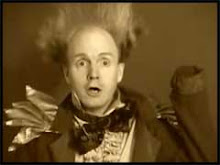
Here's one of my favorite fools, George Carl:
Foolish Exercise
The exercise here is to look at the first two minutes or so of this routine and to write or improvise a monologue for what this character might be thinking, often called an interior monologue.
I'm not saying this is something that George Carl did, but I have found for myself that an interior monologue can help with intentions, fine-tuning, presence, and timing. It can also help to bring back to life a routine that has become rote from too many repetitions.
Some may think that this is too intellectual a tool for a physical routine, but I find that it's really a trick to occupy the verbal/intellectual part of the mind so that the playful part can get past the critical guard.
Some guidelines: The monologue can be like you are narrating to yourself what you are doing and what is happening to you. Keep it simple and short—inner monologues aren't usually great poetry, deep thoughts, or even complete sentences:
Oh!
Wait a second...
How' d that...
Stuck again.
I know...
I'll move this and—
Ouch!
Walking, walking,
Falling!
Another way to practice this fool tool is to narrate five minutes of your life while engaged in some non-verbal task. As a side benefit, you'll also be practicing a form of mindfulness.
1. There can be wisdom is foolishness.
2. What you're doing isn't working.
3. You need a workable idea that is new, great, and innovative.
4. Because you don't want to be a fool.
5. You want to think like an artist.
6. You take things too seriously.
7. You like to play.
8. Life is short.
9. To free yourself from limiting thoughts.
10. You already do.
Foolish Question: Why would you want to think like a fool?


 Posts
All Comments
Posts
All Comments