Wednesday, July 1, 2009

How to Think Like a Fool #41: Act Crazily

PRETEND: Act Crazily
Mental illness is a serious health issue that should be taken extremely seriously.

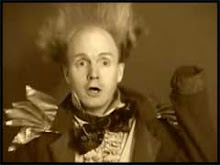
Now that that's out of the way, fools act crazy, not to mock, stereotype, or romanticize mental illness, but to get away with outrageous foolishness. Based on their behavior, fools are often labeled as insane, even when they have perfectly sane reasons for what they do. Once labeled, they don't need to justify their actions—it's very simple to an outsider, they do what they do because they're nuts. Then fools are free to act accordingly.

Some people fear that if they pretend to be looney, their tenuous grip on reality may be relaxed, and they'll go over to a world of lunacy. Even though they most likely have nothing to fear, these people might feel safer by simply acting eccentric, or having an object or piece of clothing to ground them when they imagine themselves slipping away. They might want to move crazily instead of thinking crazy thoughts.

You act crazily to escape self-consciousness, to go outside your comfort-zone, and to come up with ludicrous solutions that work nonetheless. You learn quick ways to bring playful energy into a mad, mad, mad, mad world that claims to be sane.


Think: How will I act crazily today? What can I do in the privacy of my own home that would get me called insane?

Tomorrow: How to Think Like a Fool #42: Fool Others

Previous "How to Think Like a Fool" Posts


Tuesday, June 30, 2009

How to Think Like a Fool #40: Do the Wrong Thing

PRETEND: Do the Wrong Thing
While sharing similarities with doing the opposite, trying a bad idea, and breaking the rules, doing the wrong thing lets fools break free from the constraints of culturally dictated proper behavior by pretending to be ignorant of etiquette. They act improperly to thwart authority and maybe even authoritarianism.

In his book Clowns, John Towsen describes the medieval practice of "...the Feast of Fools, a New Year's celebration where the minor clergy were allowed to usurp the functions of their superiors and engage in a wide range of blasphemous yet officially approved clowning." Everything gets turned upside down with reverent mockery.

You can get so caught up in being perfect, succeeding at all costs, and knowing you are right, that you effecively block yourself from creative solutions. Imagining and listing the wrong things to do in a situation frees you up to question whether they are truly incorrect or just what the daffy doctor ordered.

You are expected to eat with knife and fork at a steakhouse, but at an Ethopian restaurant, you eat with your hands.

Think: What's the right thing to do? What's the wrong thing to do? How many ways can I act improperly here?

Tomorrow: How to Think Like a Fool #41: Act Crazily

Previous "How to Think Like a Fool" Posts


Monday, June 29, 2009

How to Think Like a Fool #39: Change Identity

PRETEND: Change Identity
"The mask which an actor wears is apt to become his face."—Plato

“Before you criticize someone, you should walk a mile in their shoes. That way when you criticize them, you are a mile away from them and you have their shoes.”

—Jack Handey


Pretending, for the fool, is where imagination and play meet. Using tools common to actors and children, fools change their approach to a problem by make-believing they are someone else. By doing so, they tap into and practice characteristics they didn't think they had, bringing to life one of their many selves. When Harry Langdon, playing the roles of sheriff and photographer, needs to put out a fire in the short film "Smile Please", he puts on a firefighter's hat.

When I'm working on a routine, I often take some time to imagine how Buster Keaton or Harpo Marx or some other physical comic would act in that situation, and then I improvise as if I were one of them performing. I wouldn't win any look-alike contests, but I always come up with ideas I never would have conceived of without changing character. Then I adapt the ideas, if appropriate, to my own persona.

You put on a disguise, a mask, or a costume, and let them affect how you act and feel. Change how you move. Observe how others move and imitate them. Imagine a genius or a fool working on the problem and then act like that person. Think of a personality trait you think would come in handy, but which you don't think you possess, then play at having that trait, until you own it.

Of course, always choose wisely who you become:

Think: Who would I like to be? What part of my personality would I like to change? Who could best solve this problem? How will I change my identity?

Tomorrow: How to Think Like a Fool #40: Do the Wrong Thing

Previous "How to Think Like a Fool" Posts


Thursday, June 18, 2009

How to Think Like a Fool #38: Be Serious

PLAY: Be Serious
"Life does not cease to be funny when people die any more than it ceases to be serious when people laugh."
—George Bernard Shaw

"Comedy is simply a funny way of being serious."—Peter Ustinov

"My work is a game, a very serious game."—M.C. Escher

This is the last fool tool under the category of Play and it's about being absolutely, deadly serious. Stand up straight! Wipe that smile off your face! Have fun!

In the past, I've spent all morning in my rehearsal studio figuring out ways to "accidentally" make a wooden easel fall apart, exploring intensely the variations and subtleties of unexpected destruction. Then I take a break and think how absurd this would look to someone peeking in my window from outside, especially because of how serious I look. How serious am I? As serious as a scientist. A funny looking scientist.

And then I remember something Steve Martin once sang: "I get paid for doing this."

Fools play, and when they play deeply, they temporarily forget they are playing. Their objectives become as important as the Holy Grail, no matter how mundane. The game becomes their whole world.

No matter what you are working on, as an experiment, treat it as if humanity's survival depended on your actions. Give little things the significance of a funeral. Inflate the worthiness and urgency of your goals as if you were on an ancient quest. See if this gives your efforts more focus and concentration.

Then step back and laugh.

Think: How can I play more seriously? How important can I make this? What if this were a life or death situation?

Tomorrow: How to Think Like a Fool #39: PRETEND:Change Identity

Previous "How to Think Like a Fool" Posts


Wednesday, June 17, 2009

How to Think Like a Fool #37: Make Music

PLAY: Make Music
George Carlin did a short routine where he vocalized film soundtrack music to accompany his life, "otherwise, it's all wasted time." (click link to listen to mp3 excerpt)

Add a soundtrack to your life, find the rhythms in your actions, play your problems like an instrument, sing away your troubles, dance to your inner drummer. You get the joy of making music combined with the quieting of brain chatter, so that playful solutions float to the top.

Be like Stomp or Ernie Kovacs and transform your world:


Making music is a simple way to turn everyday activities into a game, while tapping into your musical intelligence for new perspectives and insights. If you are too embarrassed to make music, listen to a film soundtrack on your personal musical listening device and act along with it as you go through your day. I personally recommend Ben Model's alternate silent film soundtracks.

Think: What's a way to make music with what I'm doing right now? Inner or outer soundtrack? Percussion? Make up a song about what I'm doing? Listen to the world as if it were a symphony?

Tomorrow: How to Think Like a Fool #38: Be Serious

Previous "How to Think Like a Fool" Posts


Tuesday, June 16, 2009

How to Think Like a Fool #36: Fool Around

PLAY: Fool Around

First some "unconstructive silliness" from Monty Python:

By acting without reason, but with maybe one foot still grounded in reality, fools fool around, mess around, play around in casual frivolity. It's pure play and unstructured improvisation, without apparent goals, and the only rule is there are no rules. One dictionary even uses the word irresponsible in the definition.

It's that state of mind where you are not too serious, lightly detached, a little lazy, willing to be messy and make mistakes. You doodle around with your problem or an idea until something gells and more ideas take you by surprise--or you take them by surprise. You work from your instincts and impulses without censoring, seeing what comes to mind and body. By not focusing on finding a solution, accidents will happen that solve the problem anyway.

I'm not sure where this originates (I first heard it in a creative writing class taught by Daniel Keyes), but it's been taught as an approach to creative writing that writers should figuratively vomit on the page and clean it up later. The first part (vomiting) has been called Free Writing, and its principles can be adapted to any creative endeavor. I've found Gabriele Rico's clustering technique as a quick way into the fooling around state.

Think: Why not fool around for awhile and see what happens?

Tomorrow: How to Think Like a Fool #37: Make Music

Previous "How to Think Like a Fool" Posts


Monday, June 15, 2009

How to Think Like a Fool #35: Secretly Cooperate

PLAY: Secretly Cooperate
[I apologize once again for the delay in postings. A family emergency took precedence, and may do so again. Thanks for the patience.—Drew]

Yesterday, I was out riding my bicycle, when a traffic light turned red. I stopped, grumbling about the law, but obeying it, even though no cars were coming. Really, though, I was catching my breath and appreciating a break from pedaling.

Your problem is your adversary, in a game that threatens its very existence. You draw energy from this competition, while secretly you cooperate with the problem by working with it instead of against it. Resistance is futile!

In stage combat, actors appear to be fighting, while in reality they are working together to provide a convincing illusion of dramatic conflict. In this way, no one gets hurt while the visual language of the choreography speaks with poetic metaphor.

A game of tag is less fun if we stand there and I tag you, then you immediately tag me, then I tag you again, and so on. Or else I'm it, and I never tag you because you're too fast and too far away. We play together to keep the game going.

A child may tease the person they have a crush on. Someone, when not just being a jerk, may play devil's advocate to strengthen someone else's position. A sailor takes his sailboat on a zig-zag course to go against the wind, using the power of the wind. It looks like they seek a win-lose situation, when it's actually win-win.

A tai-chi master absorbs the impact of his or her opponent to softly neutralize the energy of the attack, redirect it, and exhaust it. Injury only comes from tense resisting.

In the same way, you incorporate the given circumstances of a problem into the solution, instead of trying to eliminate them. For example, you may have the problem of always losing your keys. Next time you come home, you consciously lose them under a pile of dirty laundry, and with that absurd act, you are more likely to remember where you put them the next day.

Think: How can I secretly cooperate with my problem? What if I appeared to be fighting it while actually playing with it to win-win?

Tomorrow: How to Think Like a Fool #36: Fool Around

Previous "How to Think Like a Fool" Posts