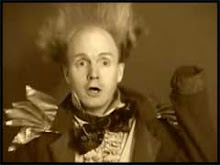
I have an extra copy of Hugh Macleod's fantastic new book, Ignore Everybody: And 39 Other Keys to Creativity. I'll send it to the person who leaves my favorite comment below on how they have used one of my How to Think Like a Fool concepts to creatively solve a problem.
Thursday, June 11, 2009
Win a Free Copy of "Ignore Everybody" by Hugh Macleod


How to Think Like a Fool #34: Use What's Handy
 PLAY: Use What's Handy
"And if you can't be with the one you love, love the one you're with."
—Stephen Stills
When life gives you lemons, make incredibly sour lemonade—unless life gives you water and sugar, too.
Fools don't want to drive all the way to Home Depot to pick up the perfect tool or part. They enlist what's available, wherever they are, whatever they have. They think like MacGuyver and invent like Rube Goldberg.
In Buster Keaton's The Boat, his wife's pancakes prove to be inedible, but later provide a plug for a hole in the boat with the help of hammer and nails (which caused the hole in the first place). Later, he uses the hammer to nail himself to the floor while the boat is flipping over.
We often live with the myth that if we just had [fill in the blank], all our problems would be solved. Only being able to use what's handy forces you to be creative. You have to connect the unrelated, make and break rules, and transform functions of objects. The limitations take away the infinite options that take too long to consider. You begin to see the project as a whole, instead of its separate parts, as demonstrated here by the fool Nasrudin:
Why Don't You
Mullah Nasrudin went to the shop of a man who stocked all kinds of bits and pieces.
"Have you got nails?," he asked.
"Yes."
"And leather, good leather?"
"Yes."
"And twine?"
"Yes."
"And dye?"
"Yes."
"Then why, for Heaven's sake, don't you make a pair of boots?"
—from The Pleasantries of the Incredible Mulla Nasrudin by Idries Shah
But to always have handy what you might need, you could carry around a Fool's Aid Kit.
Think: What do I have handy right here, right now? How can I use these to solve the problem?
Tomorrow: How to Think Like a Fool #35: Secretly Cooperate
Previous "How to Think Like a Fool" Posts
Tuesday, June 9, 2009
How to Think Like a Fool #33: Use More Effort Than Necessary
 PLAY: Use More Effort Than Necessary
Fools read a book on thermodynamics when they want to fix the furnace. They run like mad to catch a turtle. They push on a door with all their might when the door reads PULL. They lift a feather with the moves of an olympic weightlifter. They overexert, over-prepare, overshoot, and overbite.
By doing so, they live in a heightened state of play, outside the comfort zone, on the extreme edges where there are new ideas under the sun. It's exaggeration in action, and making things more difficult in hindsight.
You use more effort than necessary when you need a jump-start to go from an object at rest to an object in motion; when you are too cautious and careful to make an impact; when the goal is faraway; when you don't really know how much effort it will take; when success was worth the excess energy expenditure and inevitable exhaustion.
On the other side, fools also succeed by using less effort than at first seemed necessary. A little push of a snowball has big consequences when it reaches the bottom of a snowy hill.
Think: How much mental or physical effort does this need? Can I double or triple it? How hard can I push myself? Or what if I used a miniscule fraction of effort instead?
Tomorrow: How to Think Like a Fool #34: Use What's Handy
Previous "How to Think Like a Fool" Posts
Monday, June 8, 2009
How to Think Like a Fool #31: Compete with Yourself
 PLAY: Compete with Yourself
Continuing on with the concept of fools playing games, here they take on their most formidable opponent—their own selves. It's the only fair competition, because they are evenly matched, and even when they lose, they win.
Some people play even chess with themselves.
Similar to being in front of an audience, competition can give you an adrenaline boost or cause anxiety or both. Ideally, competition encourages you to perform at your best and push yourself beyond your self-imposed limits.
Psychologists theorize that we don't have one self, but many selves that come into play depending on the circumstances. If this is the case, we have a whole team of players available to us, pitting the better ones against the worst ones.
If crowds have wisdom, then why not draw upon the wisdom of the crowd inside your head? Your own diversity of opinions leads to personal group genius.
Here are some ways to use the idea of use self-competition (some that would also fit under the FoolThink categories of Imagine and Pretend):
- Set a numerical goal. Come up with 25 different ideas, for example.
- Set a timer and see how many solutions you can come up with in 15 minutes.
- Set a stop watch and see how quickly you can come up with a solution.
- Try to beat your past selves by bettering your best times.
- Provide conflict by interfering with your efforts. Make things more difficult!
- Imagine that any second someone could come into the room and foil your activity. Be absolutely quiet so they don't hear you.
- Take turns with different aspects of your personality. Have your angry side work on a problem, then your calm and relaxed side.
- Try to make each attempt to solve a problem qualitatively better than the one before it.
- Picture someone else working on the same problem. Don't let them win.
- Decide on a reward if you solve the problem within set limits. Or implement a foolish punishment if you don't—hop on one foot for twenty minutes.
Have fun playing with yourself!
Think: What am I competing for? How will I compete with myself? Which parts of me will I tap into?
Tomorrow: How to Think Like a Fool #32: Use More Effort than Necessary
Previous "How to Think Like a Fool" Posts
Saturday, June 6, 2009
How to Think Like a Fool #30: Make and Break the Rules
 PLAY: Make and Break the Rules
"Rule Six: There is NO... Rule Six."
—Monty Python
Fools look for games everywhere. If they can't find them, they make them up. If they get bored, they add new rules. If they aren't getting what they want, they break the rules. If that's not enough to win, they'll start a brand new game.
Games have goals, strategies and tactics, limited time and space, fun (essential!), and rules. The rules give structure that frees you up for creative expression. Too many choices lead to indecisive paralysis. Too many rules, and the thrill is gone.
Look at your problem as a game, figure out what the rules are, then go from there.
In a stage play, fools can be participants in a story, then suddenly step outside the action, break the imaginary fourth wall, and comment on the events as if they were members of the audience. In a similar way, you can be utterly immersed in a game, then stop and see it for what it is, just a game, one you most likely invented yourself, and with arbitrary rules ready to be challenged, broken, and changed.
Finally, learn from a master (click thumbnail to enlarge):

Think: What game am I playing? What are the rules? What rules can I make up? What rules can I break? How do I get out of this game and start a new one?
Tomorrow: How to Think Like a Fool #31: Compete with Yourself
Previous "How to Think Like a Fool" Posts
Thursday, June 4, 2009
How to Think Like a Fool #29: Act without Reason
 PLAY: Act without Reason
Despite what you may believe, foolish thinkers are quite rational. They have their own logic and reasons, often built on questionable premises, that only look irrational from the outside. But sometimes, they take motive out of the equation, just because.
Still, there may be reasons hidden behind their nonsense.
Your marvelous intellect can get in the way of puzzling out answers. Luckily, you also have intuition, so if you take purpose out of your actions, other parts of your brain can kick in while you relax the struggle to figure things out.
Meaningless acts also befuddle your inner critic, reducing that interfering voice to, “This makes no sense!"—which you already knew and was exactly what you were going for. Success!
When you do things for their own sake, you'll become more present, which can be a very pleasurable place to live. And when people ask why you have lobsters in your hair, you can truthfully say, "No reason."

There was an old man of Blackheath,
Whose head was adorned with a wreath,
Of lobsters and spice,
Pickled onions and mice,
That uncommon old man of Blackheath.

There was an old man in a garden
Who always begg'd every-one's pardon;
When they asked him, 'What for?'
He replied, 'You're a bore!
And I trust you'll go out of my garden.'
—Edward Lear
Think: What can I do for no reason? What can't I do for no reason?
Tomorrow: How to Think Like a Fool #30: Make and Break the Rules
Previous "How to Think Like a Fool" Posts
Wednesday, June 3, 2009
How to Think Like a Fool #28: Manipulate Time and Space
 PLAY: Manipulate Time and Space
One of the seemingly magical things about theatre (and film) is how time and space can be manipulated before our eyes. In Henry V, Shakespeare refers to this ability to create large events in a small stage over a limited amount of time:
“Can this cockpit hold
The vasty fields of France? Or may we cram
Within this wooden O the very casques
That did affright the air at Agincourt?”
—William Shakespeare, Henry V, Prologue
With the imagination of an actor, the illusionary skills of a mime, and the power of a film editor, fools alter the laws of physics to change perceptions and explore new sources for ideas. As a side benefit, they get to look silly using them.
When you play, you can do something backwards, in fast motion or slow motion, change the sequence of events, do a small actvity in as large a space as possible, or do something that takes a lot of space in a tiny area. Play as if you're in a different space and keep changing it. Stop time. What if you jumped forward an hour, a week, a century? Act like you're caught in a surreal, dreamlike world.
Just don't cause a rift in the time/space continuum. Thanks.
Here's one of my favorite cartoons—Daffy Duck in Chuck Jones' Duck Amuck, partly inspired by Buster Keaton's Sherlock, Jr.:
Think: What can I do differently with time or space? How can I shape, change, and mess around with them?
Tomorrow: How to Think Like a Fool #29: Act without Reason
Previous "How to Think Like a Fool" Posts
Subscribe to:
Posts (Atom)

 Posts